A step-by-step guide to finding and hiring an app developer
You might be thinking, “I have a great idea and I want to build an app, but where do I start?”
The obvious answer is with the idea. But before you invest time and money in a mobile app, there are a few things to think through first.
Building an app is fairly straightforward. Getting off the starting block is the complicated part. This guide is here to help you get started without the stress.
Let’s get going.
1. Introduction
Picture yourself on a trivia app, playing a few games. Maybe it’s how you unwind, or how you fill the time before a flight. As you work through the questions, you start to wonder how much effort went into making the app.
Anyone who works in app development and marketing knows the answer: a lot. A company or person has to come up with a concept, do market research, design the wireframes and graphics and plan the launch. It’s usually done by a team, and the app developer is one of the most important people on it.
The developer turns your idea into a working product, which is why choosing the right one matters.
2. How to find an app developer
Search for an app developer and you’ll quickly find more options than you could ever get through. There are hundreds of them.
But how many are actually qualified to build the app you want? Probably far fewer than you’d think. Someone knowing how to build an app doesn’t make them the right developer for your app.
Plenty of freelancers know the basics of coding and can put together a working app. That doesn’t mean they can build an e-commerce app or an internal business communication app. Those are more complex, and they need a developer or team with experience in that area.
So how do you know which developers suit your app? It’s hard if you don’t know what to look for, and that’s why we wrote this guide. Use it as a detailed checklist when you’re choosing developers. Once you know what to look for, finding the right match gets a lot easier.
Here’s how, where and when to find an app developer for your idea or business.
The steps to finding and hiring an app developer
Here’s an overview of the process before we get into the detail:
- Research your app idea and define what you want to achieve.
- Decide whether you need an in-house team, a freelancer or a development agency.
- Find potential developers and create a shortlist.
- Prepare your project requirements and request proposals.
- Assess experience, portfolios, technical capabilities and support.
- Meet your preferred candidates and agree on scope, costs, contracts and ownership.
Each stage is explained in more detail below.
Before you start looking at app developers, ask yourself these questions:
- Have I validated my idea and done enough research?
- What purpose does it serve? What problem does it solve, or what value does it give users?
- Who is my target audience?
- Do I have an initial business or project plan?
- Do I want an in-house team or a freelancer?
- Do I want an app for iOS, Android or another operating system such as Windows?
- Do I want a native, hybrid or web app?
- What type of app is it: lifestyle, social media, utility, games and entertainment, productivity or news and information?
- Should the app integrate with other systems, such as a CRM or a payment system?
- Do I have a marketing plan and budget for after launch?
It also helps to understand the basics of what app developers do. Which programming languages do they use? What are the average rates? Knowing something about the profession and the process gives you the context for productive meetings and interviews.
3. The basics of app development
An app, short for “application”, is a software program built to perform specific tasks or functions on a computer, smartphone, tablet or other electronic device. Apps range from simple tools to complex software, and they provide services, entertainment, utilities or information.
The key point is that apps aren’t only built for phones, and they aren’t only built for Android or Apple. They’re built for many operating systems, including Windows, Tizen, Linux, KaiOS, ChromeOS, LuneOS, GrapheneOS and more.
The second thing to consider is the type of app you want to build. That doesn’t mean a game or a social app. It means native, hybrid or web. Each type has its own benefits and drawbacks, and different apps need different functionality, so choosing isn’t easy.
Web-based app
A web-based app is accessed through a web browser on a mobile device or desktop computer. It isn’t installed on the device the way a native app is, and it doesn’t have the same direct access to the device’s hardware. It can still reach some device capabilities through web APIs, for example geolocation, camera access, push notifications and offline storage.
A web-based app usually needs much less space on the user’s device, because much of its data can be stored on an internet server. Google Docs and Dropbox are examples.
Native app
A native app is built for a single platform, such as iOS or Android. An app made specifically for the Apple iPhone is built for Apple’s operating system and won’t automatically work on Android phones.
It’s installed directly on the user’s device and can use the device’s hardware and features, such as the camera, GPS and sensors. Native apps usually offer strong performance and a good user experience because they’re optimised for the platform. They’re distributed through app stores such as the Apple App Store and Google Play Store. The calculator app on the iPhone is a native app.
Hybrid app
A hybrid app is built with web technologies such as HTML, CSS and JavaScript, then wrapped in a native container so it can run on several platforms. It combines web-based and native apps.
These apps can be easier and quicker to build, because one codebase can be used across platforms. But hybrid apps can have performance limitations compared with native apps, depending on what the app needs to do.
The choice between native, hybrid and web depends on performance requirements, target audience, development resources and the need for platform-specific features. Each approach has advantages and limits, and the decision should come from the goals and constraints of your project.
4. The mobile app development process: from idea to launch
App development is a fairly standard, straightforward process. It covers strategy, design, development and deployment, much like any other software project. If you’ve never been involved in software development before, though, parts of it may feel long.
Why does design take so many steps? Why does everything need testing all the time? What are these iterations anyway? Knowing how the process works from day one saves you a lot of questions and makes the experience more engaging.
How to develop an app in 9 steps
- Find or establish a development team. Building a mobile app takes a talented, mixed team: a product manager, UX/UI designer, mobile developer, quality assurance analyst and digital marketer. Consider your budget and needs when you put the team together.
- Do competitive research. Research competitors and market needs so you understand what sets your app apart. Talk to potential users for useful insights.
- Outline the core features. Define the essential features, including simplicity, speed, cross-platform functionality and features that keep users engaged. Keep your budget in mind when you decide on extra features.
- Create mock-ups. Mock-ups let you visualise how the app should look and work. They’re useful for team collaboration and investor presentations. Tools you can use include MockupBuilder, Balsamiq and Mockplus, to name a few.
- Plan app security. Make security a priority through encryption, authorised APIs, strong authentication and ongoing testing for vulnerabilities.
- Start coding. Code the front end and back end of the app, coordinate the work efficiently and test in a controlled environment.
- Run multiple tests. Thorough quality assurance testing throughout development checks front-end and back-end functionality, device compatibility, app integration, application type, installation, storage and security.
- Gather and apply user feedback. Involve a test group for feedback before launch. Keep collecting feedback and reviewing analytics after the app is live, so you can keep improving it.
- Launch in the app store. Prepare the app for publication in the app stores, following their specific rules. Consider building a cross-platform app for broader reach.
5. Upskill yourself and your knowledge
When you’re explaining your idea to developers, it’s normal to feel a bit flustered trying to get the finer details across. Developers can be tricky to communicate with. They can sound as if they’re speaking another language, and it can feel as if you need to learn a new dialect.
You might think you asked for something simple and not realise you just added 40 hours of development time to the project. Or you might think something is impossible when it would take a few minutes to implement.
As a beginner, getting a basic grasp of the key terms makes it much easier to work with developers and make informed decisions. That might seem obvious, but it’s not obvious to everyone. Go into every meeting knowing what you’re talking about, with a solid understanding of the objectives and how to reach them. The more you know, the more effectively and efficiently you’ll communicate with your developers.
For help along the way, “App Development for Dummies” books by A Wiley Brand is a beginner-friendly introduction to app development concepts. Websites such as W3Schools, Mozilla Developer Network and freeCodeCamp also have thorough guides and tutorials that can make the terminology less daunting.
Common developer terms to know
A few common terms will help you ask better questions when you interview app developers and review their proposals. You don’t need to become a programmer, but knowing what developers mean by front end, back end, APIs and frameworks makes it easier to understand what they’re proposing to build and what you’re paying for. Here are some terms for your next conversation with a developer.
Back end
The back end is the behind-the-scenes working of a website or app, or what’s “under the hood”. It’s the building blocks that make a project run. You normally can’t see these elements when you’re using the site or app.
Front end
The front end is everything users see and interact with on your website or app. Front-end developers commonly code in JavaScript, CSS and HTML.
Full-stack
You may have heard the term “full-stack” developer. What does it mean? A full-stack developer knows enough technologies to finish an entire product: the back end, the front end and the database. Keep in mind that there are many kinds of stacks, such as web stacks, mobile stacks and native application stacks.
DevOps
DevOps is short for “Development and Operations”. It’s a movement that brings development, quality and operations teams together to improve communication and collaboration. Smooth communication helps projects run more efficiently and produce more stable releases.
Frameworks
A framework is a collection of components, programs and tools used for development. Developers could gather each of these building blocks and tools separately, but a framework puts them all in one place. Common frameworks include Ruby on Rails, React and Angular.
Applications
Applications, also called “apps”, provide functions to users or to other applications. That could be something inside your photo or editing software, a website, a word processor or even a customer-support program such as Zendesk.
Bugs
Bugs are generally unwelcome, in the real world and in development. In development, a bug is a glitch in the code that stops a program or website from running correctly.
API
API stands for “Application Programming Interface”. Put simply, it’s how different software applications communicate with each other.
UI
UI stands for “user interface”. It’s what users see on the front end when they interact with your software.
CSS
CSS is short for “Cascading Style Sheets”. It’s the code that tells your browser how your website should be displayed, including global styles for menus, fonts, colours and more.
CSS3
CSS3 is the modern generation of CSS features. It works with HTML and other web technologies to create responsive, interactive websites.
HTML
HTML stands for “HyperText Markup Language”. It’s the standard coding language for creating web pages, and one of the most basic building blocks a developer needs to build a website.
HTML5
HTML5 is the modern standard of HTML. It works with CSS and JavaScript to create responsive web applications and websites.
Responsive web design
Responsive design is an approach to web design and development where the website responds to the user’s device. On a desktop, mobile device or tablet, the site adjusts so that it looks, feels and works properly.
6. Do market research on your idea
You’re reading this for a simple reason. You have a brilliant idea for an app and you want to make it real. You need a professional or a team who understands your requirements, has the technical expertise, can create a user-friendly design and can deliver a customised mobile app within your budget and timeframe.
But hold on for a second. Have you validated your idea? Have you done detailed mobile app market research? Not doing enough market research puts your app development investment at risk.
What is app market research?
Market research helps you identify the need for your app and what it’s worth in the market. Thorough research helps you answer these questions:
- Is there a need for your app?
- Who is the target audience?
- Who are your competitors?
- Does your app give more value than competitors’ apps?
- Do you have a business model that makes money?
If you don’t do the market research and find answers to these questions, you risk your money and your time.
This article isn’t meant to explain how to do research in detail, but it’s important to touch on it:
- Know your audience. Understanding your target users is essential for effective app research. Identify basic demographics such as age, location, language and gender. That knowledge streamlines the development process.
- Gather reliable data. Real-time statistics are important for app research and improvement. Use trustworthy sources such as Gartner, Statista, Google Trends, Pew Research, Gallup and Knoema for data and insights.
- Use social media. Social media is a treasure trove of information. Keep up with trends and gather insights from platforms such as Instagram, X, LinkedIn, Facebook, Pinterest and YouTube. Looking at competitors on social media can also be valuable market research.
- Know your competitors. Studying competitors is a normal part of business research. Understand their strengths, weaknesses, opportunities and threats.
- Do a SWOT analysis. Work through Strengths, Weaknesses, Opportunities and Threats to identify the internal and external factors affecting your app.
Remember that every successful business started as a start-up. Looking at competitors, understanding your target audience and keeping up with reliable data are the key parts of effective app market research.
7. Define your project, business objectives and budgets
Developers like specifics, so they’ll arrive at your first meeting expecting a concrete plan.
Create a detailed description of your idea
To get the best start and the best cooperation from your app developer, whether that’s an independent developer or part of a development house, you need to be able to explain your idea, and your business plan should be as detailed and clear as possible.
Before the first meeting, write a thorough description of your app. It should cover what features it should have, how it should look and who it’s aimed at. Here are six things to include in your app idea pitch.
Create an MVP plan
Outline the core features of your app, focusing on its main purpose. This Minimum Viable Product, or MVP, helps developers understand the fundamentals of your idea.
For example, if the app will be used to sell smartwatches, don’t go into specific details about the watches. Mention that users will be able to browse a catalogue of smartwatches and buy one. The purpose is to help the development team get to the core of your idea.
Create flow charts
Visual aids such as flow charts, showing the different app screens and user actions, simplify a potentially complex process and help developers understand the user journey.
If you’re developing an e-commerce app, for example, make screen images for the different steps in the app, such as creating an order. If you have the technical expertise, create detailed flow charts for “if-then” scenarios. For example, if the user opens the app for the first time, they’re taken to a welcome page where they fill in details such as:
- name
- email address
- phone number
Tools such as Lucidchart and SmartDraw can help with this.
Explain each app function
Give detailed explanations of every function you plan to include. Be concise and use simple language to get across as much detail as possible. Here are a few features you may want to mention when you explain your app idea:
- video call
- chat
- picture upload
- push notifications
- user login features
- social sharing
Set realistic deadlines and budgets
Every software development project has a deadline, and you need to discuss and finalise the budget for the app so there are no surprises later. Stay open to a different deadline, though, and only finalise it after talking to the development team.
You also need to settle the final cost of development with the company. Billing shouldn’t come as a surprise or a disappointment later on. Timeline and budget are often directly related, so it’s best to discuss them together. That helps set expectations and keeps the conversation with your team about what is and isn’t possible.
Create visual mock-ups
If you can, build high-fidelity visual mock-ups to show the design elements, colours and overall look of your app. This helps the development team understand your brand and its digital extension. Flow charts show what you want, and visual mock-ups show how you want it to look.
Create user stories
User stories are crucial for communication between you and the development team. A user story describes the app’s audience, what they want and why. This agile development tool helps developers understand user needs, prioritise features and plan releases.
Including these elements in your pitch improves mutual understanding between you and the development team and paves the way for a smoother, more efficient development process.
Plan your budget
The budget for mobile app development is a critical factor in how well your team selection works out and in the quality of the final product. It can be a challenging task, because you have to look carefully at your cash flow, both incoming and outgoing, and adjust as needed. Sometimes you may need to take calculated risks and make financial sacrifices to stretch your budget so the project succeeds.
At this point it’s essential to decide on your priorities. Do you want an efficient mobile app solution that delivers an exceptional user experience and takes your business to new heights, or are you content with a budget-friendly, average product that merely establishes your digital presence without making the most of it?
8. Where to find an app developer
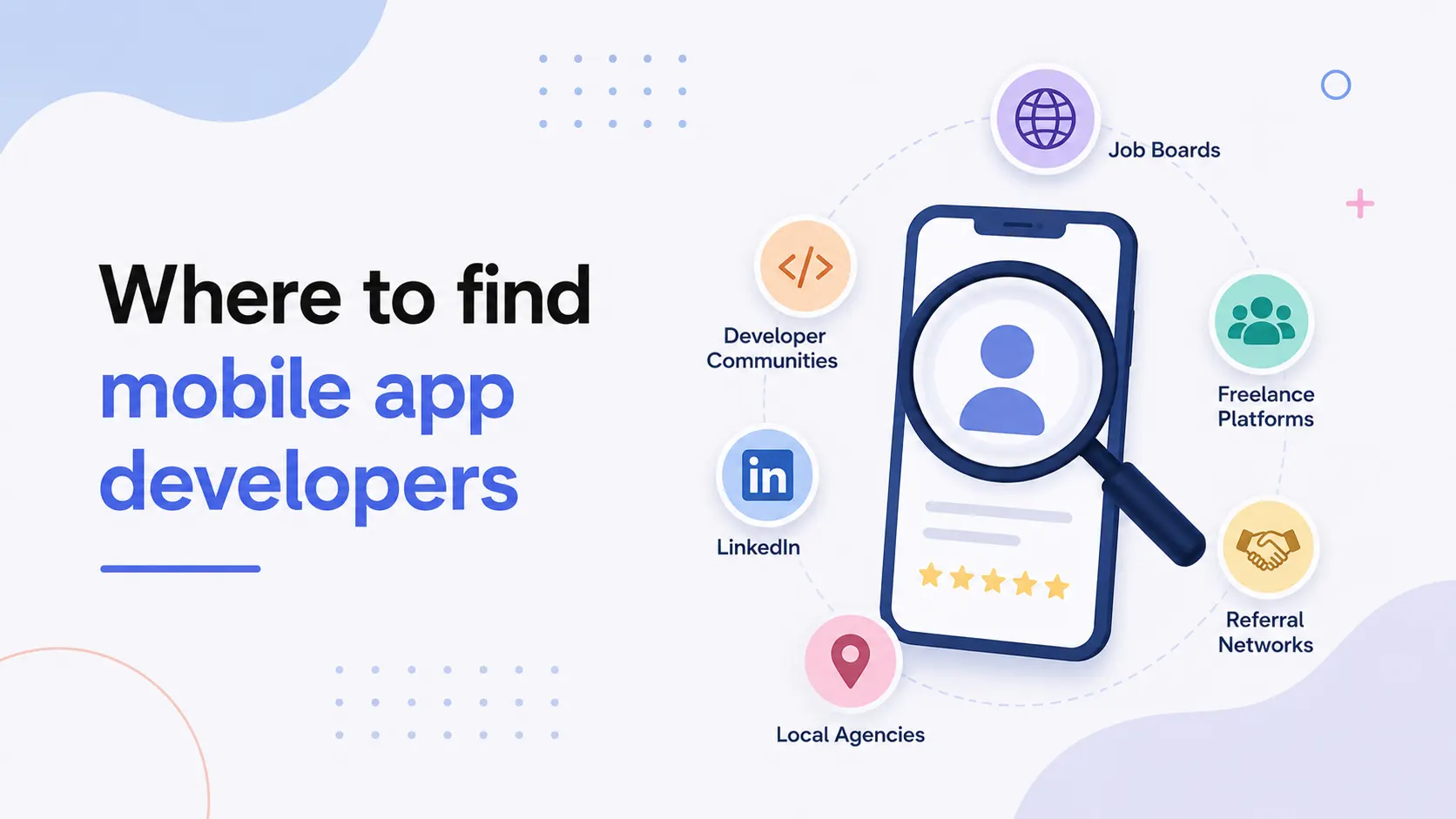
Now that you’ve done your preparation and understand the process, you might be wondering where you’ll find this person or team. It’s actually a fairly simple research process, but take your time and research all your options carefully. You can start your search for a developer or agency in a few places.
Freelance websites
If you’re going the freelance route, top freelance sites such as Toptal, Freelancer, Fiverr and Hired are one place to look These sites often show clear rates, so you can see from the start what a freelancer may cost.
Tech blogs
Blogs such as Wired, The Verge and TechCrunch are a good resource when you’re looking for an app developer. They typically have articles about app development and the whole process, so you go in better informed.
Creative communities
There are online communities where designers and developers upload portfolios and samples of their work, such as Dribbble and Behance. If you find someone you like, you can reach out and get to know them better. Even Pinterest or Instagram can be a good source of inspiration.
B2B directories
If you’re going to hire an agency, look at B2B directories where companies list information, reviews and ratings. Sites such as Clutch.co, B2B Marketing, Sortlist and Relevance can all be useful.
Colleges
It’s easy to forget that colleges and universities have a lot of emerging talent. Contact professors in the computer science department and ask whether they know of any student developers.
Your network
Your own network is another place that’s easy to forget. Ask around. See if anyone you know can recommend an app developer they’ve worked with or are in touch with.
Search engines
Lastly, the holy grail. The only problem with Google, Bing and other search engines is that you need to be careful and vet the people or companies you find there thoroughly.
9. In-house or freelancer?
Before you look further at app developers, ask yourself this question: do I want to hire an in-house team or a freelancer? To answer it, think about your business needs.
Are you at an established company that wants to automate its processes? An in-house team might work well. If you work at a start-up, on the other hand, an expert specialist who can work on a specific project might be the way to go. And if you expect to build more than one app, an in-house team can work well, while for just one app a freelancer may be enough.
An in-house team is usually a group of developers who have a deep understanding of your company, its culture and its product or service. But that team is costly, because you have to cover salaries, benefits and equipment. You also need set systems and processes to keep the work productive and high quality.
A freelancer or app agency, on the other hand, can provide specialist expertise for a particular project. Depending on the scope and the people needed, that may be more cost-effective than employing a permanent development team. The downside is that you have to manage the communication and, in some cases, the project management too.
Whichever route you take, it’s important to find the right person or team. That’s why we’ve put together a list of tips to help you find an app developer.
10. When to find an app developer
Once you have a concept and you’ve done your research, you can start looking for an app developer. By this point you’ve usually identified a problem your target market has and come up with an app concept that solves it. You may have outlined some ideas for the app and even put together rough wireframes of what you want it to look like. When you get to this point, it’s probably time to find a developer to work with.
Finding an app developer is a big task, but if you vet your candidates thoroughly and stay organised with your search, the process should be fairly straightforward.
11. Write your job description and send an RFP
Now it’s time to narrow down your selection of app development partners and get closer to choosing the right one. After the long process of finding a few companies or teams for your mission-critical project, this step is fairly simple.
RFP stands for “Request for Proposal”, where you explain everything about your app development project. In short, you use everything you researched in the earlier section, “Define your project, business objectives and budgets”. In your RFP you can include:
- a project description, with the development requirements, scope and the features and functionality to be built
- your requirements for the team of designers, developers, QA engineers and others you want on your project, including the industry experience and expertise you expect
- project milestones
- your budget, from your expected lower range to your ability to scale up if they can deliver additional value
- industry regulatory standards the developers should keep in mind
- your requirement for a Service Level Agreement, for better assurance in the partnership, and an NDA to protect confidential information
- any additional instructions for your prospective IT partner to agree to and follow, such as communication methods, reporting and transparency
Once your job description for the project is written, send it to all your shortlisted teams and wait for their quotations and references.
12. Assess the proposals and quotations
At this stage it’s reasonable to expect responses from all or most of the companies you’ve contacted. Some will reply with confidence and a commitment to meet your expectations, while others may be more eager for the business. Some may not respond at all, if they decide your requirements don’t fit their client criteria or they can’t meet particular demands, such as signing a non-disclosure agreement.
In the best case, your inbox will fill up with competitive proposals, references and further requirements. As proposals come in, stay discerning and assess carefully how well the references match your needs. This helps you filter out unsuitable candidates and move to the interview stage, where you can understand their approach better.
a. Look at experience
All apps are not created equal. Anyone can learn to build a simple app such as a flashlight or calculator with basic coding. You wouldn’t want a pilot who hasn’t flown a day in their life, and you probably don’t want an app developer who has never built an app.
Ask about their experience and look at the work they’ve done. If you want to build an HR app for internal employee communication, work with a developer who has done it before. Want an e-commerce app for your Shopify store? Find a developer who specialises in that type of development. Ask for references, examples and case studies of apps they’ve built. A developer’s portfolio shows whether they have experience building apps like the one you need.
i. Platform experience
The type of app you want to build largely decides which platforms you’ll need to build it on. Is it an iOS app? An Android app? Both? Or even less widely used platforms? Ideally, you want a developer who can build for the platforms your project needs. Otherwise you may need separate developers for different platforms, which makes coordination more complicated.
Even if you only plan to publish on one platform for now, you’ll probably want to make the app available on both eventually. A developer or agency that can build cross-platform or hybrid apps can reduce the cost and time of building two completely separate apps. For many projects, the advantages of cross-platform development outweigh the disadvantages, but the right approach depends on the requirements of the app.
b. Portfolio
The portfolio is a crucial asset for developers when they pitch to prospective clients and want to be believed on their expertise. For clients, it’s a chance to decide whether the candidate can meet the project’s requirements. So when you shortlist your app development partner, check their portfolio. It helps you:
- find similar projects they’ve worked on
- see how complex the projects, features and functionality they’ve handled were
- assess how well they deliver mobile apps with a stable user experience
- see useful suggestions they’ve given clients to improve their products
- assess how well they find solutions to problems that come up while the app is running
In short, a mobile app development company’s portfolio speaks louder than its pitch. Don’t skip this part when you’re evaluating and hiring the best-fit partner.
c. Focus on communication
Your app won’t be built well without crystal-clear communication, which is why rapport matters in the first meetings. Besides qualifications and experience, see how well you and the potential developers get along and understand each other.
d. Be clear about your business needs
When you meet with developers, be clear about the app concept and your target market. The clearer you are about your business’s needs and goals, the easier it is to build an app that meets them.
e. Use set criteria to judge each developer
It’s important to have a list of criteria for judging each developer or agency you talk to. That way your meetings are productive and your questions get answered. Consider criteria such as:
- reviews and references
- experience
- speciality
- programming tools
- development process
- legal process and contracts
- project management
- communication
These are all important areas to discuss in your first meetings. When you compare the developers on your shortlist, use the same criteria for everyone. Record what each developer tells you, but also look for evidence to back up their answers. Their portfolios, previous projects, client references and explanations of their process can help you judge whether they have the experience and skills your app needs.
Use the table below to record your findings. It makes it easier to compare candidates fairly instead of relying on memory or first impressions after several meetings.
| Criteria | Developer A | Developer B | Developer C |
|---|---|---|---|
| Reviews and references | |||
| Experience | |||
| Speciality | |||
| Programming tools | |||
| Development process | |||
| Legal process and contracts | |||
| Project management | |||
| Communication |
You might also write down a few questions on these topics. Some you could ask:
- Do you have reviews and references from past and current customers that I can read or contact?
- How much experience do you have?
- Can I see samples of your work?
- What types of apps have you worked on in the past?
- What programming tools do you use to build an app?
- What does your development process look like?
- Would you be willing to sign an NDA and a contract?
- How do you handle project management?
- How will we communicate during development?
- What are your fees?
f. Developer availability
Cost often plays a big part in people’s decision when they’re finding an app developer. But one of the most important factors is availability. Let us explain.
A freelancer is one person. They may be working on several projects at the same time, so they can’t necessarily give your app all their attention. An app development agency, on the other hand, may have a wider team of developers who can work on your project together. That can give you extra capacity and continuity, depending on the agency’s staffing and other commitments.
What if the freelancer you hire gets sick? Or gets hurt? Or has a problem on another project that can’t wait? It may sound unlikely, but you’d be surprised. We’ve seen it happen. Your app development could slow down because the developer is no longer available. With an agency, other team members may be able to carry on with your app when someone becomes unavailable. That’s why it’s important to ask about availability and continuity before you choose your developer.
g. Technological requirements
When you’re looking for an app developer, ask questions about the technology. This is a big problem that we see people run into all the time. Some developers give you a base price for the development, but they leave out the price of the back-end infrastructure your app needs.
Certain things are required for your app to work once it’s live. If you want to store information about your app’s users, for example, you need a database server. Want user analytics? Then you need an analytics solution. You need authentication infrastructure if you want users to log in, and supporting technology if you want to send push notifications. There’s more, and these elements are all too often forgotten in the total price.
So when you talk to developers, explain clearly which features you want in the app. Those features affect the technological requirements. Then make sure the developer gives you a well-considered quote that includes the cost of all this technology.
h. Security
Security should be a priority for anyone building a mobile app. Make sure your developer can give you, your business and your app appropriate security features. Mobile apps are regularly targeted by malicious actors, so security needs to be considered from the start.
When you talk to a developer, stress how important security is. Ask what your options are and see what they offer. If they tell you something vague like “I’ve got it under control” or “you don’t need to worry about it”, that’s cause for concern. Developers should be able to tell you specifically how your app will be secured. Security levels vary depending on the type of app you’re building.
i. Support after development
Let’s fast-forward a bit. Your app has been built. It’s live, it can be downloaded and people are already using it. It’s fantastic. But what now? Does the developer just disappear and leave you to fend for yourself?
You can’t make an app, release it and forget about it. Think of your app like a new car you’ve just bought and driven out of the parking lot. You’re not done maintaining that car. It still needs oil changes, tyre rotations and other regular maintenance, and when something goes wrong, you have to fix it.
Your app isn’t perfect, and it probably never will be. You’ll always be able to make changes and adjustments with updates. In short, your app will need updates, so find a developer who can do this for you.
j. Location
When you’re looking for an app development service provider, the location you target matters, because every country has a different economy, which may work in your favour on talent and cost. When you target a location or country, also check that the team will understand the language you speak and can communicate with you effectively.
k. Company size
Knowing the size of the mobile app development providers you’re considering can help you judge how reliable and well-resourced the team may be. Some companies with fewer staff may bring in freelancers or developers from partner companies to work on your project. That doesn’t necessarily make them unsuitable, but you need to understand who will actually work on your app and who is responsible for delivery.
When you evaluate a company, ask whether it has enough capacity to support the project and what happens if a key team member becomes unavailable. Company size alone doesn’t show whether a developer is suitable. What matters is whether the team has the expertise, availability and resources your app needs.
l. Pick the right cost model for you
There are various engagement and cost models, suited to different requirements and circumstances. Choose the one that best meets your needs.
Fixed price. If your development requirements are clear, a fixed-price engagement can work well, because the project is delivered to an agreed scope, budget and timeline.
Variable price: time and materials. Here your hired team works on the project and bills you for the time and resources used. It’s often suggested when the scope is likely to change during development.
Dedicated team. This model gives you access to a selected development team that works on your project for an agreed period, such as a week, a month or a year. It can give you direct access to the team and may suit larger or ongoing development needs.
m. The company’s reputation
Now comes the important task of checking the background and reputation of the mobile app development company. Read client testimonials, independent reviews and any other information you can find. This may help you assess areas such as:
- the number and type of projects completed
- project history
- customer feedback
- client retention
- relevant industry experience
- the quality of previous work
Don’t rely only on star ratings. Look at how relevant and how good the company’s previous work is, and whether its clients seem satisfied with the outcome.
13. Hold a meeting, discuss your project and negotiate
Once you’ve thoroughly evaluated the proposals, you may find three or four that have genuinely impressed you. To work out which proposal and team can best serve your needs, arrange a virtual or in-person meeting with the prospective developers or teams.
A meeting gives you a deeper look at their approach, lets you discuss your project requirements and shows you how much expertise they have. It helps you make a better-informed decision about which team is best suited to deliver a mobile app solution that meets your needs. After that, you may want to discuss and negotiate several areas.
Budget
You may already have given a budget, so this is usually about discussing how it fits the scope and requirements of the project. Before you agree to go ahead, make sure you understand exactly what the quotation includes and what falls outside the agreed price. Discuss how additional features or changes to the original requirements will be handled, how extra work will be charged and when payments are due.
You should also establish what the developer will deliver at the end of the project, including any agreed source code, documentation and other project assets. These arrangements should be clearly written into the agreement so both parties understand their responsibilities.
Non-Disclosure Agreement (NDA)
An NDA helps make sure sensitive information you give the service provider stays confidential, under the terms of the agreement.
IP transfer
IP stands for intellectual property. Think about it before you engage a service provider, so it’s clear who owns the product and the project assets when the work is done. In mobile app development, intellectual property may include:
- product designs
- source code
- technical documentation
- project assets
- other agreed deliverables
Make sure the agreement clearly explains what you will own and at what point ownership transfers to you.
Non-solicitation or non-hiring agreement
Depending on the project and the relationship, the parties may agree to restrictions on directly employing or soliciting each other’s team members for a set period. If these restrictions are included, the agreement should clearly explain what they cover and how long they apply.
Once the requirements and agreements are satisfactory to both parties, congratulations: you’ve chosen your development team and can move forward with the project.
Conclusion
It can be daunting to build an app from scratch. But if you follow this guide and do some research of your own, it gets easier step by step. The most important thing to remember is to have clearly defined goals from the start.
So are you looking for a reliable mobile app development partner for your next project? iSolve Mobility can take you from design and development through to deployment, with support after launch. Share your requirements with us to discuss your next app development project.